


 English
 Español
 عربى
عربى
Every bedding program we ship starts with the same question: which comforter set will actually sell? We are Yancheng Rainbow Textile Co., Ltd., and we have been manufacturing and exporting home textiles from Yancheng, Jiangsu for more than two decades. In that time the comforter set has quietly become one of the most useful products in the category. It gives a retailer a complete look in a single box, gives an importer a clean purchase order, and gives a hotel a replaceable layer that never needs a separate duvet cover.
What follows is the practical version of what we have learned on the factory floor and in buyer meetings. No marketing language, just the fabric choices, construction details, piece counts, and sourcing questions that decide whether a program runs smoothly for the next three seasons.
Content
- 1 What Is a Comforter Set, Exactly?
- 2 Comforter Set, Quilt Set, and Duvet Cover Set: What Is the Difference?
- 3 Fabrics: Where Every Comforter Set Conversation Starts
- 4 Construction Details That Justify a Better Price
- 5 Printed or Solid Color? Read the Market Before You Decide
- 6 Piece Counts, Sizes, and Retail Positioning
- 7 A Sourcing Checklist We Use With Every New Comforter Set Buyer
- 8 Care Guidance Worth Passing On to Your Customers
- 9 Let Us Help You Build the Right Comforter Set Program
What Is a Comforter Set, Exactly?
A comforter set is a coordinated bedding package built around one quilted, filled comforter. The comforter is different from a blanket because the fill is stabilized with stitching, whether that is box quilting, diamond quilting, or channel quilting, so the material stays where it should stay after repeated washing. Around that core, a set usually adds matching pillow shams, and in larger configurations a bed skirt, a decorative cushion, or both.
The word "set" is doing a lot of work in this category. A three-piece comforter set is normally one comforter plus two shams. Five-piece and seven-piece versions add a bed skirt or decorative pillows, and nine-piece configurations often dress a full bed with additional cushions and layered pieces. Buyers should always confirm the exact contents before quoting, because the same product name can mean different things between suppliers.
One more distinction is worth keeping clear for your customers: a comforter is used exactly as it comes out of the bag, while a duvet cover is a shell that needs a separate insert. That single difference shapes pricing, packaging, care instructions, and return rates.
Comforter Set, Quilt Set, and Duvet Cover Set: What Is the Difference?
These three formats sit next to each other on most bedding shelves, and customers often ask which one belongs on their bed. The table below summarizes how we explain the difference to buyers who are building an assortment.
| Format | What Ships in the Box | Typical Fill and Feel | Best Suited To |
|---|---|---|---|
| Comforter Set | Comforter, two shams, optional bed skirt or cushion | Polyester, microfiber, cotton, or bamboo fill with medium to high loft | Retail bedding programs, hotel refurbishment, holiday gifting |
| Quilt Set | Quilt, two shams | Light fill or no fill, flat and breathable | Warm climates, layering, summer promotions |
| Duvet Cover Set | Duvet cover, two shams | Cover only, insert sold separately | Design-led brands and customers who change looks often |
Fabrics: Where Every Comforter Set Conversation Starts
Fabric and fill are the two decisions that cannot easily be undone later, so we always settle them first. Here is how the main options behave in production and in the market.
Cotton
Pure cotton remains the benchmark for hotel and premium retail programs. It breathes, it takes dye evenly, and it develops a soft hand after a few washes. The trade-off is price volatility and shrinkage, which is why pre-shrinking and controlled finishing matter as much as the yarn itself. Printed cotton comforter sets are our most requested cotton item, because the print carries the style and the fiber carries the credibility.
Polyester and Soft-Washed Microfiber
Polyester and microfiber give you sharp print reproduction, easy care, and a very competitive landed cost. A soft-washed or brushed finish removes the synthetic feel that buyers used to complain about, and the fabric resists fading and pilling well. For volume-driven programs and seasonal promotions, this is usually the smartest base cloth.
Bamboo Fiber
Bamboo fiber has moved from niche to mainstream in the last few years. It feels smooth and cool against the skin, manages moisture well, and gives a perceived value that supports a higher retail price. Bamboo is often blended with cotton for softness or with polyester for strength and stability, and each blend behaves differently under heat setting, so sampling before bulk production is essential.
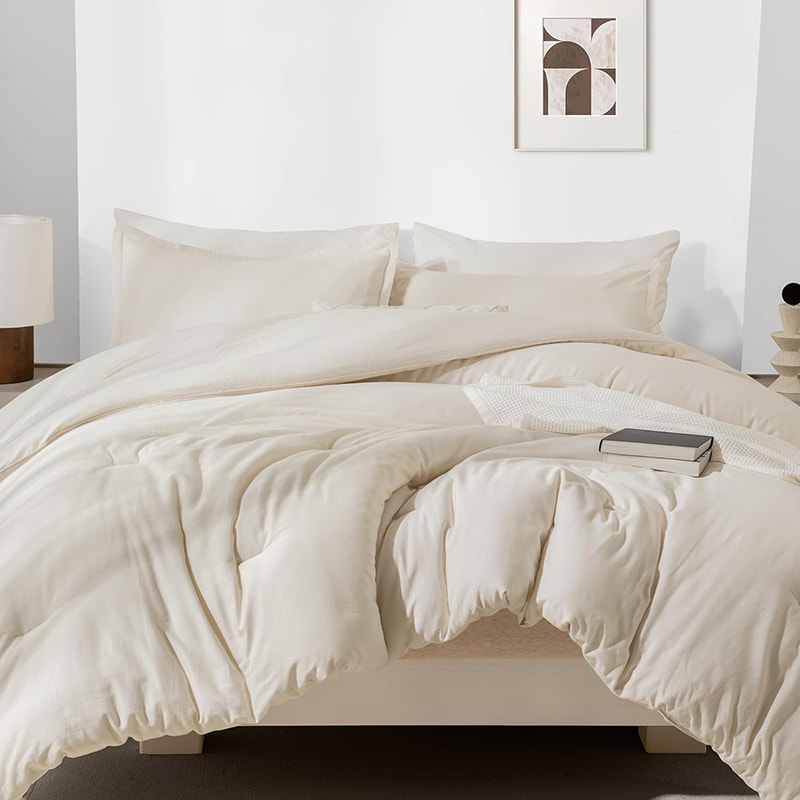
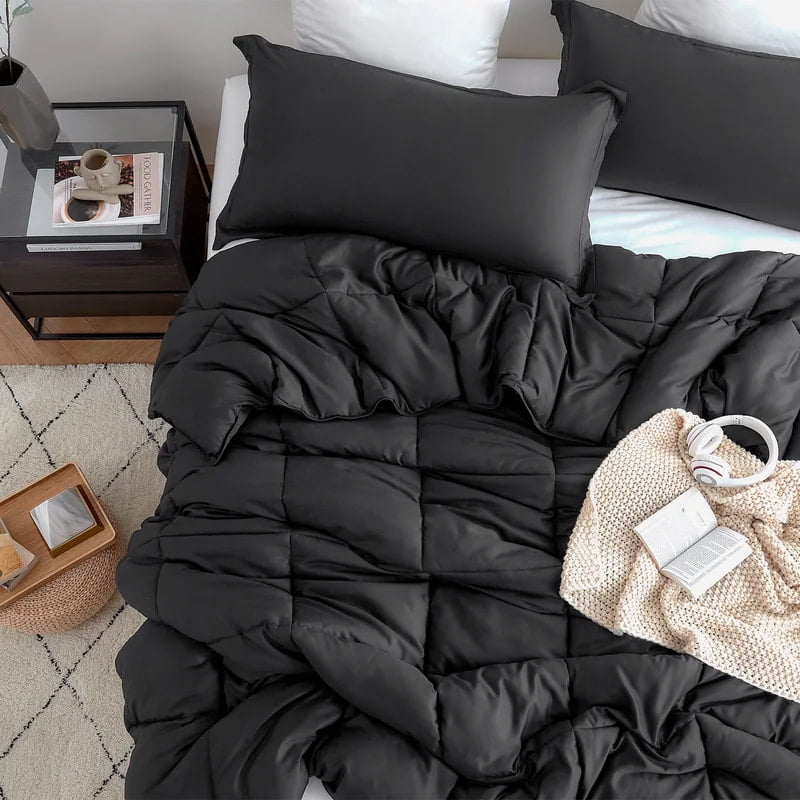 Smooth Solid Color Bamboo Fiber Comforter SetThis high-quality bamboo fiber quilt three-piece set combines natural and environmentally friendly materials with advanced craftsmanship design. The bamboo fiber fabri...View Product →
Linen
Linen comforter sets serve a specific customer: someone who wants texture, a relaxed look, and breathability over a crisp finish. Wrinkles are part of the aesthetic rather than a defect. Sales volumes are lower, but margins are usually healthier.
Plush, Velvet, and Faux Fur
These are winter products with strong visual appeal. Imitation rabbit fur, lamb cashmere, and velvet finishes sell well in cold-climate markets and during gift seasons, and they photograph beautifully for online listings.
Construction Details That Justify a Better Price
Two comforter sets can use identical fabric and still feel like different products. The difference is in construction, and construction is where a supplier's experience shows.
Woven and Textured Techniques
Jacquard weaving creates pattern through the structure of the fabric rather than on top of it, which gives a subtle sheen and a longer life than surface printing. Seersucker brings a permanent crinkle, waffle adds a grid of texture, pleating introduces volume, and tufting creates soft raised shapes. These techniques raise the cost per unit, but they also remove the product from direct price comparison, which is often exactly what a brand needs.
Ultrasonic Quilting
Ultrasonic quilting bonds the layers with heat instead of thread. There are no needle holes, no loose thread ends, and the pattern edges stay crisp, which suits geometric designs and diamond patterns particularly well. It is a strong choice for programs where consistency across large quantities is critical.
Embroidery and Clipping and Carving
Embroidery adds a handcrafted quality that photographs well in lifestyle images, while clipping and carving creates a raised, sculpted surface. Both are best used as accents on borders or central panels so that the production time stays reasonable.
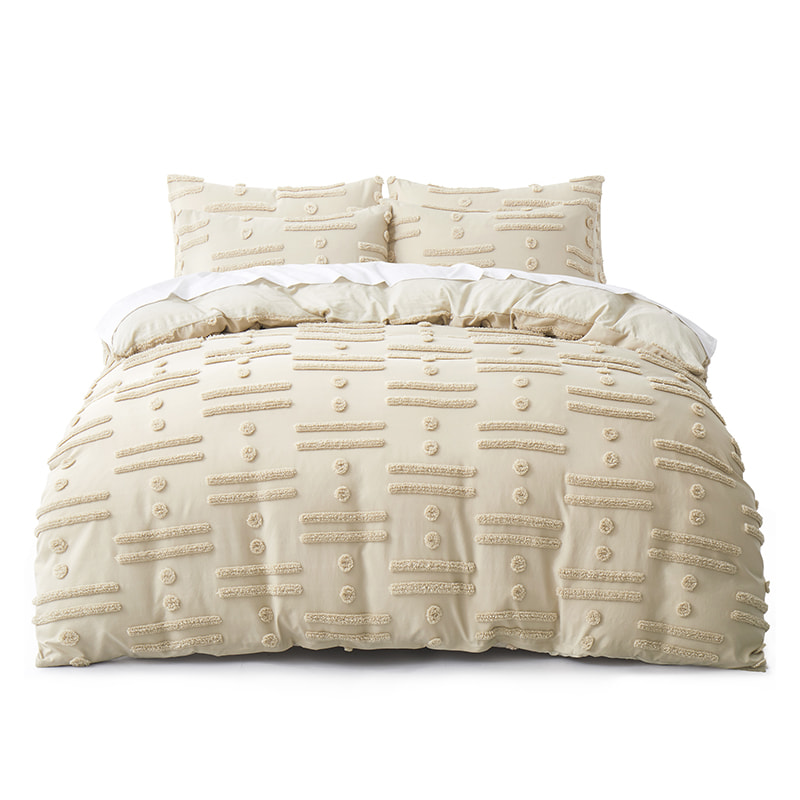 Geometric Style Tufted Comforter SetThis is a velvet duvet set with different geometric shapes, which is a high-quality bedding that combines aesthetics and practicality. It has won the love of consumers...View Product →
Printed or Solid Color? Read the Market Before You Decide
Printed comforter sets do the heavy lifting when a customer wants to change the mood of a bedroom without buying furniture. Floral, geometric, animal, and holiday patterns such as Christmas and autumn themes all perform well when they are launched at the right moment. Solids do the opposite job: they stay on the shelf all year, they reorder predictably, and they photograph cleanly on any background. Most successful programs carry both, with prints driving traffic and solids driving repeat orders. If you want a closer look at how prints behave across a season, our notes on printed comforter sets are a useful starting point.
Pure cotton printed comforter sets sit at the center of this strategy for many of our buyers, because the print delivers the trend and the cotton delivers the repeat purchase.
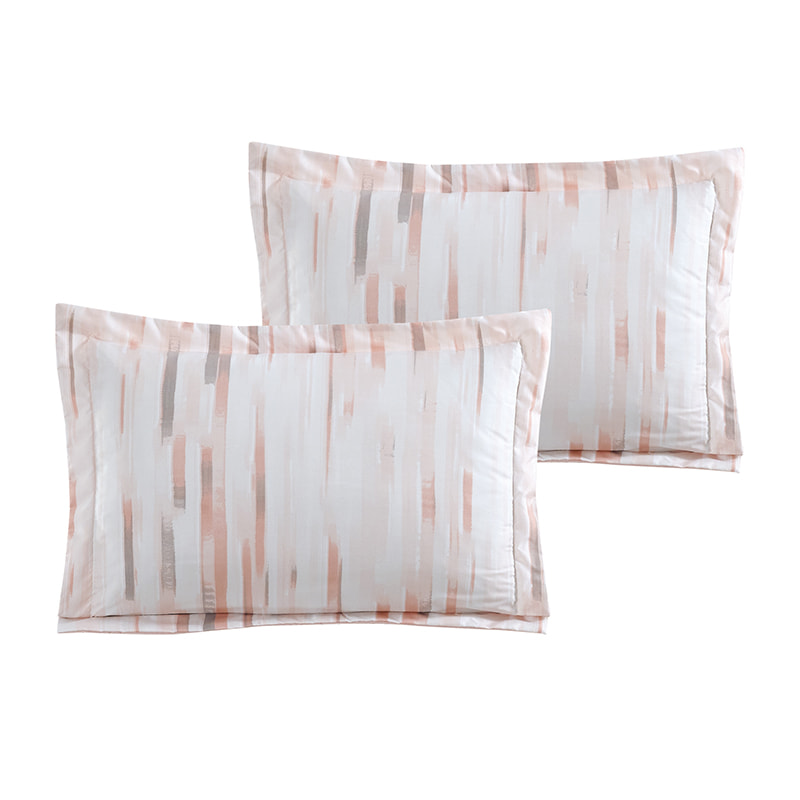 Soft and Skin Friendly Printed Pure Cotton Comforter SetThis high-end 8-piece quilt set combines high-quality pure cotton fabric and soft polyester fiber filling, aiming to provide you with unparalleled comfort and warmth e...View Product →
Piece Counts, Sizes, and Retail Positioning
Configuration is a merchandising decision as much as a manufacturing one. In our experience, these groupings cover most buyer needs:
- Three-piece sets for entry price points and single beds.
- Four-piece and five-piece sets for mainstream queen programs.
- Seven-piece sets for promotional bundles with a bed skirt and cushions.
- Nine-piece sets for premium in-store displays and gift packaging.
Sizes should follow the destination market: North American twin, full, queen, and king, or the metric equivalents used in Europe and the Middle East. Confirm the exact dimensions, fill weight, and sham size in writing, because a ten-centimeter difference is enough to make a set look unfinished on the bed.
A Sourcing Checklist We Use With Every New Comforter Set Buyer
- Define the target retail price and work backward to a realistic fabric and fill.
- Confirm the exact contents of the set in writing, piece by piece.
- Approve a physical sample before bulk production begins.
- Agree on fill weight and loft, since these drive warmth and perceived quality.
- Check color fastness and shrinkage standards for the destination market.
- Specify packaging, from poly bag to color box, early in the process.
- Plan the size curve and pattern mix by season, not by order.
- Leave lead time for sampling and repeat orders before peak retail weeks.
Care Guidance Worth Passing On to Your Customers
Care instructions protect the product and reduce complaints. Comforter sets should be washed in cold or lukewarm water on a gentle cycle with a mild detergent, then dried on low heat with a couple of dryer balls to redistribute the fill. Avoid bleach and fabric softeners, which coat the fibers and reduce breathability. Shams and bed skirts should be treated as separate items so that the comforter keeps its shape. For plush and faux fur finishes, air drying is usually the safest option. Printed fabrics benefit from being washed inside out, which helps preserve pattern depth over many cycles.
Let Us Help You Build the Right Comforter Set Program
Whether you are a retailer refreshing a bedding aisle, an importer assembling a container mix, or a hotel buyer updating rooms in phases, the right comforter set comes down to matching fabric, construction, and piece count to the customer you already have. We manufacture cotton, polyester, microfiber, bamboo, linen, and plush sets in printed, solid, and textured constructions, and we are glad to walk through sampling with you before you commit. If you would like to discuss specifications, packaging, or lead times, please talk with our service team and we will help you put the details in order.

 +86-159 5050 0822
 peter@rainbowhomefashion.com
 No.199 Yimin Road, Dateng DIstrIct, Yancheng City. Jiangsu Province, China