


 English
 Español
 عربى
عربى
If you've been sleeping under a quilt that feels stiff after washing, pills after a few months, or just never feels quite right against your skin, a soft washed microfiber quilt is worth a serious look. The washed finish isn't just a marketing term — it refers to a specific finishing process that fundamentally changes how the fabric feels and behaves. This article breaks down exactly what that means, how washed microfiber quilts are constructed, how to pick the right one, and how to keep it in good condition for years.
Content
- 1 What "Soft Washed" Actually Means for Microfiber Fabric
- 2 How a Washed Microfiber Quilt Is Constructed
- 3 Soft Washed Microfiber vs. Cotton Quilt: An Honest Comparison
- 4 Choosing the Right Washed Microfiber Quilt for the Season
- 5 What to Look for When Buying: Quality Indicators That Matter
- 6 How to Wash and Care for a Soft Washed Microfiber Quilt
- 7 Common Problems with Microfiber Quilts and How to Fix Them
- 8 Storage Tips to Keep Your Microfiber Quilt in Good Condition
What "Soft Washed" Actually Means for Microfiber Fabric
Microfiber is a synthetic textile made from ultra-fine polyester or polyester-nylon blend fibers, typically less than one denier in diameter — finer than a strand of silk. At that scale, the fibers pack together densely, creating a fabric that is lightweight, tightly woven, and naturally moisture-wicking. But raw microfiber fabric, straight off the loom, can feel slightly stiff or plasticky, particularly in heavier constructions used for quilt shells.
The "washed" or "garment washed" process changes this. After weaving and dyeing, the fabric is tumbled in large industrial washing machines — sometimes with stone, enzymes, or softening agents — at controlled temperatures for an extended period. This mechanical action breaks down the surface tension of the fibers, relaxes the weave structure, and creates a slightly worn, broken-in texture that mimics the feel of fabric that has been laundered many times at home. The result is a noticeably softer, more pliable, and more relaxed hand-feel from the very first time you touch it.
For quilts specifically, the washed finish affects both the shell fabric and, in some constructions, the quilting stitches themselves. Pre-washed shells have already accommodated the dimensional shrinkage that happens during laundering, which means a soft washed microfiber quilt is less likely to pucker, distort, or change size significantly when you wash it at home. This dimensional stability is one of the most practical advantages over unwashed alternatives.
How a Washed Microfiber Quilt Is Constructed
Understanding the construction of a microfiber quilt helps you evaluate quality and predict how it will wear over time. A quilt has three fundamental components: the top shell, the fill, and the bottom shell — all held together by the quilting stitch pattern.
Shell Fabric Weight and Weave
Microfiber quilt shells are most commonly woven in a plain weave or a peach-skin finish. Peach-skin microfiber — named for the texture of a peach's surface — undergoes additional brushing or sanding after weaving to raise a fine nap, giving it a distinctly velvety, matte finish. This is the most common construction in premium soft washed microfiber quilts because it maximizes the tactile softness benefit of the washed process. Shell fabric weight typically ranges from 80 to 120 GSM (grams per square meter). Lighter shells are more breathable and drape better; heavier shells are more durable and opaque.
Fill Material and Weight
The fill in a microfiber quilt is distinct from the shell fabric and has a large impact on warmth, weight, and how the quilt lofts after washing. Most washed microfiber quilts use one of three fill types:
- Polyester fiberfill (siliconized): The most common fill for microfiber quilts. Siliconized polyester fibers are coated with a silicone finish that reduces fiber-to-fiber friction, allowing the fill to loft evenly and recover its shape after compression. Typical fill weights range from 200 to 400 GSM for a three-season quilt. Higher fill weight means warmer but heavier.
- Microfiber cluster fill: Rather than continuous fibers, cluster fill uses small balls of microfiber that move independently within each quilted section. This provides a more down-like loft and reduces the flat, uniform appearance of slab-fill quilts. It is slightly more expensive and requires box-stitch or baffle-box quilting to keep clusters evenly distributed.
- Bamboo or cotton blend fill: Some washed microfiber quilts use a natural fiber fill inside a microfiber shell. This combination targets buyers who want the soft feel and washability of microfiber shells with the breathability and natural temperature regulation of bamboo or cotton batting. These tend to be lighter and more suitable for warm-weather use.
Quilting Stitch Patterns and Their Function
The quilting stitches that hold the three layers together also determine how the fill distributes and how the quilt drapes. Common patterns in washed microfiber quilts include:
- Box stitch: A grid of squares. Simple, durable, and effective at preventing fill migration. The most common pattern in budget and mid-range microfiber quilts.
- Diamond stitch: A rotated box pattern at 45 degrees. Creates a more elegant visual appearance with similar performance to box stitch. Common in decorative or bedroom-display quilts.
- Channel stitch: Parallel lines running the length of the quilt. Good for quilts used as top layers, as it allows the fill to shift slightly for body-conforming warmth. Less effective at preventing fill clumping in the long term.
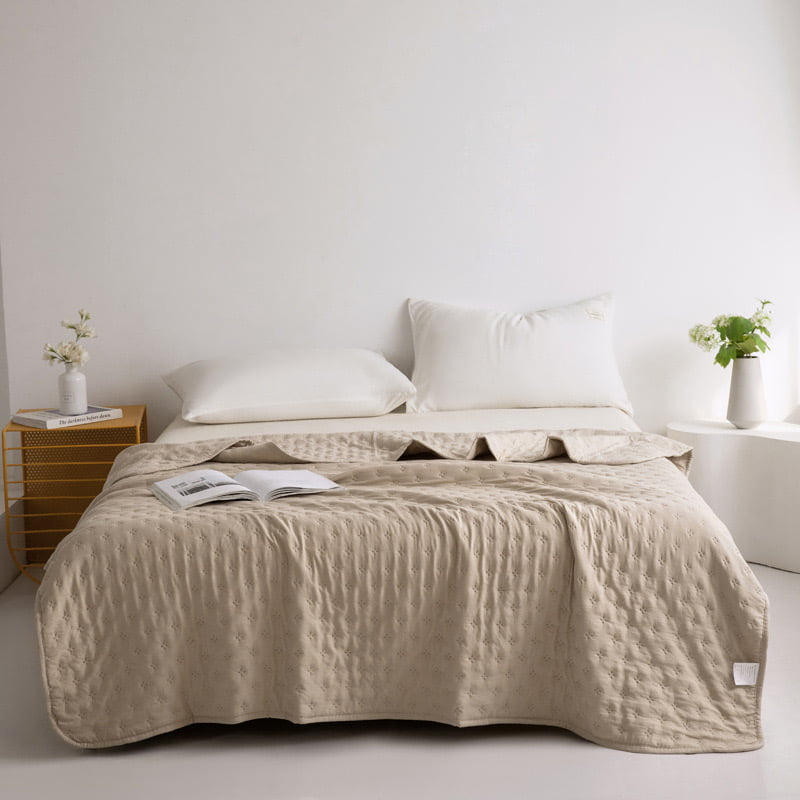
- Decorative embroidery stitch: Found in higher-end washed microfiber quilts, where the quilting itself forms a visual design — flowers, geometric patterns, or abstract outlines. These quilts double as decorative bedspreads and are typically lighter in fill weight.
Soft Washed Microfiber vs. Cotton Quilt: An Honest Comparison
The most common alternative to a washed microfiber quilt is a traditional cotton quilt. Both are widely available and used year-round, but they have meaningfully different performance profiles. Understanding the differences helps you make the right choice for your sleeping preferences and lifestyle.
| Feature | Soft Washed Microfiber Quilt | Cotton Quilt |
| Initial softness | Very soft from first use | Softens gradually with washing |
| Breathability | Moderate — traps more heat | High — naturally breathable |
| Moisture wicking | Good — pulls moisture away | Absorbs moisture, dries slowly |
| Drying time | Fast — 45–60 min in dryer | Slow — 90+ min, air dry preferred |
| Allergen resistance | High — resists dust mites | Lower unless treated |
| Weight | Light to medium | Medium to heavy |
| Price range | Generally lower cost | Wider range; quality costs more |
| Pilling over time | Possible with low-quality fabric | Minimal with good quality cotton |
| Best for | Easy care, allergy sufferers, kids | Hot sleepers, natural fiber preference |
For households with allergy sufferers, children, or anyone who wants bedding that washes and dries quickly without special handling, a soft washed microfiber quilt is the more practical daily-use choice. For hot sleepers or those who prioritize natural fibers and maximum breathability, cotton remains the better option despite its slower care routine.
Choosing the Right Washed Microfiber Quilt for the Season
Microfiber quilts are available across a wide warmth range, and selecting the right fill weight for your climate and sleeping habits prevents the common problem of overheating or being too cold. The following guidelines apply to a standard adult quilt used as the primary bedding layer:
Summer and Warm-Climate Use
For warm-weather use or air-conditioned rooms where temperatures stay above 22°C at night, a lightweight washed microfiber quilt with a fill weight of 150–200 GSM is appropriate. At this weight, the quilt provides minimal insulation and functions primarily as a top layer for comfort and coverage rather than warmth. Look for shell fabrics with a higher thread count and a tighter weave, which reduces heat retention. Some lightweight microfiber quilts use a bamboo-microfiber blend shell specifically to improve airflow in warm conditions.
All-Season and Three-Season Use
The most versatile range for washed microfiber quilts is 250–350 GSM fill weight. This suits bedroom temperatures between 16°C and 22°C — covering most of the year for temperate climates. A quilt in this fill range provides enough insulation for cool nights without trapping excessive heat. The majority of soft washed microfiber quilts marketed as "all-season" fall in this range. If your bedroom runs warm, choose the lower end of this range; if you sleep cold or have poor room insulation, choose the higher end.
Winter and Cold-Climate Use
For cold bedrooms, unheated spaces, or climates where night temperatures regularly fall below 15°C, a heavy washed microfiber quilt with fill weights of 400–500 GSM provides meaningful warmth retention. At this weight, microfiber quilts can substitute for a duvet in many households. The trade-off is weight and drying time — heavier fill takes longer to dry thoroughly after washing, and incomplete drying leads to odor and mildew development in the fill. Make sure your dryer can handle the quilt size, or plan for extended air drying.
What to Look for When Buying: Quality Indicators That Matter
The microfiber quilt market spans a wide price range, and price alone is not a reliable indicator of quality. These are the specific features worth checking before purchasing:
- GSM of both shell and fill: Reputable manufacturers specify both figures separately. If a product listing only gives a total GSM without distinguishing shell from fill, it's difficult to assess what you're actually getting. Ask or look for a full spec sheet.
- Thread count and fiber denier: Higher thread count shells (above 100TC for microfiber) are more tightly woven and resist pilling better. Lower denier fiber (0.5–1D) produces softer fabric than higher denier (2–3D), which feels coarser. The finest washed microfiber quilts use ultra-fine 0.2–0.5D fibers in the shell.
- Quilting stitch density: More stitching means better fill containment and less migration over time. Check that stitching lines are even and that the spacing between stitch lines is consistent. Uneven or loose stitching is a sign of low manufacturing quality and will worsen with washing.
- Edge and binding finish: The binding around the quilt perimeter takes the most mechanical stress during use and washing. Look for double-turned or overlocked binding stitched in two passes. Single-stitched bindings fray quickly and are the most common early failure point on budget quilts.
- OEKO-TEX or similar certification: Since microfiber is a synthetic material, residual chemical treatments from manufacturing — including dyes, finishing agents, and softeners — can irritate sensitive skin. OEKO-TEX Standard 100 certification confirms that the product has been tested for harmful substances. This is especially worth checking for quilts used by children or allergy sufferers.
- Color fastness disclosure: The washed finish process can affect dye stability. Check that the product specifies colorfastness ratings or confirms that the quilt does not bleed color during washing. Dark-colored washed microfiber quilts in particular should be washed separately the first few times regardless of manufacturer claims.
How to Wash and Care for a Soft Washed Microfiber Quilt
One of the genuine advantages of a microfiber quilt over down or wool alternatives is its washability. Most soft washed microfiber quilts can be laundered at home without professional cleaning, but the process matters for maintaining loft, softness, and fill distribution.
Washing Instructions
- Use a front-loading washing machine wherever possible. Top-loaders with central agitators can stress quilting seams and cause uneven fill distribution. If a top-loader is the only option, use the gentlest cycle available.
- Wash at 30°C to 40°C on a gentle or delicate cycle. High-temperature washing accelerates fiber breakdown in synthetic microfiber and can cause the washed finish to revert to a stiffer texture over time.
- Use a mild, liquid detergent without optical brighteners or bleach. Powder detergents can leave residue in the dense microfiber weave that is difficult to fully rinse out, leading to stiffness after drying.
- Do not use fabric softener. Liquid fabric softener coats microfiber filaments and progressively reduces both softness and moisture-wicking performance — the opposite of its intended effect on this fabric type. The washed finish already provides the softness; no additional softener is needed.
- Run an extra rinse cycle to ensure all detergent is fully removed, particularly for heavier fill-weight quilts where detergent can become trapped in the fill layers.
Drying Instructions
- Tumble dry on low heat. High heat can melt or fuse fine microfiber filaments, causing permanent texture change. Low heat drying takes slightly longer but preserves the fabric's feel.
- Add two or three clean dryer balls to the drum during drying. Dryer balls break up clumping fill and restore loft significantly faster than drying without them. Tennis balls wrapped in a clean cotton sock work as an effective substitute.
- Pause the dryer every 20 minutes to redistribute the quilt inside the drum. Fill migrates to one end during tumbling and dries unevenly if not periodically redistributed.
- Ensure the quilt is completely dry before storage or use. Even slight residual moisture in the fill layer leads to mildew growth and a persistent musty odor that is very difficult to remove once established. Press the fill sections firmly — if they feel dense or cool to the touch, continue drying.
- For air drying, lay flat on a clean surface or drape over two parallel drying rails to allow airflow on both sides. Do not hang by one edge — this causes fill to slump to the lower edge under its own weight and creates permanent unevenness.
Common Problems with Microfiber Quilts and How to Fix Them
Even high-quality soft washed microfiber quilts develop problems over time or with improper care. Here's how to address the most frequently encountered issues:
- Pilling on the shell surface: Pilling occurs when microfiber filaments break and tangle into small balls on the fabric surface. It is accelerated by friction, high-heat washing, and tumble drying at high temperature. Mild pilling can be removed with a fabric shaver. To prevent recurrence, reduce wash temperature and dry on low heat. Washing the quilt inside a mesh laundry bag reduces friction against other items in the drum.
- Fill clumping after washing: Fill clumps form when wet polyester fiberfill compresses and bonds together before fully drying. The fix is to dry with dryer balls at low heat, pausing frequently to break up clumps by hand. For severe clumping, a second full wash and careful tumble dry with aggressive redistribution usually restores an even fill distribution.
- Loss of softness after washing: If a washed microfiber quilt feels stiffer after laundering, it is almost always due to detergent residue in the fibers or use of too-high wash temperature. Run a rinse-only cycle with no detergent, then tumble dry with dryer balls. This usually restores softness. Switching to a smaller amount of a gentler liquid detergent for future washes prevents recurrence.
- Musty odor after drying: This indicates incomplete drying. Re-wash and dry with extended drying time. Add half a cup of white vinegar to the wash cycle — it neutralizes odor-causing bacteria without damaging the fabric. Do not use high heat to speed up drying as a fix; this will damage the fill fibers.
- Stitching coming loose at the binding: Binding seam failure is typically a manufacturing quality issue that becomes apparent after a few washes. Minor loose stitching can be repaired with a hand needle and thread. For extensive binding failure on a relatively new quilt, contact the retailer — this usually qualifies as a manufacturing defect under standard consumer warranty terms.
Storage Tips to Keep Your Microfiber Quilt in Good Condition
Between seasons, proper storage prevents fill compression, odor development, and fabric degradation in washed microfiber quilts. The key principles are airflow, dryness, and avoiding sustained compression.
- Always store a clean quilt. Body oils, skin cells, and residual moisture in an unwashed quilt create the ideal environment for dust mites and mildew during storage.
- Use a breathable cotton storage bag rather than a sealed plastic bag or vacuum storage bag. Sustained vacuum compression permanently deforms polyester fill fibers, reducing loft and insulation value. Plastic bags trap any residual moisture and encourage mildew growth.
- Store in a cool, dry location away from direct sunlight. UV exposure through a window can fade microfiber dyes over time, particularly in darker-colored quilts.
- Place a cedar block or breathable sachet of dried lavender in the storage bag to deter moths and maintain a fresh scent during storage. Avoid mothballs — the chemical odor is very difficult to wash out of microfiber fabric.
- Take the quilt out of storage a day before use and shake it vigorously or tumble in the dryer on a no-heat air cycle for 20 minutes. This restores loft that has compressed slightly during storage and airs out any closed-storage mustiness.

 +86-159 5050 0822
 peter@rainbowhomefashion.com
 No.199 Yimin Road, Dateng DIstrIct, Yancheng City. Jiangsu Province, China