


 English
 Español
 عربى
عربى
Content
- 1 Why Buying a Sheet Set Is More Complicated Than It Should Be
- 2 Fabric Types: The Single Biggest Factor in How Sheets Feel
- 3 Thread Count: What It Means and When to Stop Paying Attention to It
- 4 Weave Types and How They Change the Feel
- 5 What's Included in a Sheet Set and What to Watch For
- 6 Sizing Your Sheet Set Correctly
- 7 How to Match Sheet Sets to Your Sleep Style
- 8 Caring for Your Sheet Set to Make It Last
Why Buying a Sheet Set Is More Complicated Than It Should Be
Walk into any home goods store or scroll through bedding online and you'll find sheet sets ranging from $20 to $500, all claiming to be soft, breathable, and durable. The marketing language is almost universally vague — "hotel quality," "ultra-soft," "premium feel" — and the specs listed (thread count, fabric type, weave) are often misrepresented or stripped of context that would make them useful. The result is that most people buy a bed sheet set based on price and packaging, sleep on it for a week, and then start wondering why it pills, fades, or feels nothing like what they expected.
This guide cuts through the noise by focusing on the variables that actually determine how a sheet set performs in practice: fabric type, weave construction, thread count in context, fit, and what to expect at different price points. Once you understand those factors, choosing a sheet set becomes a straightforward decision based on your sleep preferences rather than a guessing game based on product copy.
Fabric Types: The Single Biggest Factor in How Sheets Feel
The fabric a bed sheet set is made from determines almost everything about the sleeping experience — how warm or cool it feels, how it handles moisture, how it softens over time, and how long it lasts before wearing out. Thread count and weave matter within a fabric type, but comparing thread count across different fabrics is meaningless. A 400-thread count cotton percale and a 400-thread count polyester blend will feel completely different and perform differently over their lifetimes.
Cotton
Cotton is the most widely used sheet fabric and the baseline against which most other materials are measured. Its appeal comes from a combination of breathability, moisture absorption, durability, and the way it softens gradually with washing rather than feeling stiff or artificial. Not all cotton is equivalent, however. Long-staple cotton varieties — Egyptian cotton and Pima cotton (also sold under the brand name Supima in the US) — are made from cotton fibers longer than 38mm, which produce a finer, smoother yarn with better tensile strength and a softer hand feel than shorter-staple standard cotton. Long-staple cotton sheets are more expensive and genuinely worth the premium if softness and longevity are your priorities. Be cautious about "Egyptian cotton" labeling: the name has been heavily misused in bedding marketing, and independent testing has repeatedly found products labeled Egyptian cotton to contain significant proportions of shorter-staple cotton or blends. Look for certifications like OEKO-TEX or Cotton Egypt Association verification if this distinction matters to you.
Linen
Linen sheets are made from flax plant fibers and have a texture and performance profile distinctly different from cotton. Fresh out of the package, linen feels noticeably rougher and more textured than cotton — a quality that puts some buyers off immediately and appeals strongly to others. The key is that linen softens significantly with each wash, and after 20–30 washes most people find it comparable to well-worn cotton in softness while retaining a characteristic slight texture that many find pleasant. Linen's main functional advantage is thermoregulation: it is highly breathable and moisture-wicking, absorbs up to 20% of its weight in moisture without feeling damp, and transfers heat away from the body more effectively than cotton. This makes a linen sheet set the preferred choice for hot sleepers, humid climates, and anyone who finds conventional cotton sheets uncomfortably warm. The trade-off is price — quality linen sheet sets are among the most expensive in the bedding market — and the fact that linen wrinkles easily and does not have the smooth, crisp appearance that some people expect from a made bed.
Microfiber and Polyester
Microfiber sheets — made from very finely woven polyester fibers — are the dominant choice in the budget sheet set category, and for good reason at the price point. They are soft immediately out of the package, resist wrinkling, dry quickly, and are significantly cheaper to produce than quality cotton or linen. The practical limitations become apparent over time and for certain sleepers: polyester does not breathe the way natural fibers do, trapping body heat and moisture against the skin rather than dissipating it. Hot sleepers and anyone who sweats during sleep will likely find microfiber sheets uncomfortable regardless of their softness. Pilling — the formation of small fiber balls on the sheet surface — is also more common in lower-quality microfiber after repeated washing. For a guest room, a child's bed, or anyone who runs cold and prioritizes softness over breathability, microfiber is a perfectly practical choice. For everyday primary bedroom use by adults, natural fiber options generally perform better over the medium to long term.
Bamboo-Derived Fabrics
Sheets marketed as "bamboo" are almost always made from viscose rayon or lyocell processed from bamboo pulp — not from bamboo fibers directly woven into fabric. The processing method matters: lyocell (often sold under the brand name TENCEL) uses a closed-loop solvent process that recovers and reuses the dissolving agent, making it significantly more environmentally benign than conventional viscose rayon production. Bamboo-derived lyocell sheet sets have a soft, silky hand feel, reasonable moisture management, and perform comparably to mid-range cotton for most sleepers. The sustainability claims on bamboo bedding packaging require scrutiny — the raw material is sustainably fast-growing, but the chemical processing involved in converting bamboo pulp to usable fiber varies significantly in environmental impact depending on the method used.
Thread Count: What It Means and When to Stop Paying Attention to It
Thread count is the number of threads woven per square inch of fabric — horizontal (weft) plus vertical (warp) threads combined. It became a marketing shorthand for sheet quality sometime in the 1990s and has since been one of the most consistently misused metrics in consumer bedding. The core problem is that thread count is only a meaningful quality indicator within a consistent fabric type and weave construction. Across different fabrics and weave methods, it tells you very little.
The inflation of thread count numbers is a well-documented industry practice. Manufacturers boost stated thread counts by using multi-ply yarns — twisting two, three, or four thinner threads together and counting each individual strand rather than each twisted yarn. A sheet with a "600 thread count" achieved this way using 3-ply yarns may have the same actual weave density as a single-ply 200-thread count sheet, but with a heavier, less breathable fabric as a result. In long-staple cotton percale, a thread count of 200–400 using single-ply yarn is the sweet spot for breathability, durability, and softness. Numbers above 400–500 in cotton percale are usually the result of multi-ply counting or the use of finer, less durable yarns packed more densely. For sateen weaves, slightly higher thread counts (300–600 in single-ply) are common and appropriate to the construction. For linen, thread count is rarely stated because linen fibers are much thicker than cotton and a genuinely high-quality linen sheet might have a thread count of only 80–150.
Weave Types and How They Change the Feel
Within a given fabric type, the weave construction is the variable that most directly determines how a sheet feels against your skin. The two dominant weave types for cotton sheet sets are percale and sateen, and they produce genuinely different sleeping experiences from the same raw material.
Percale Weave
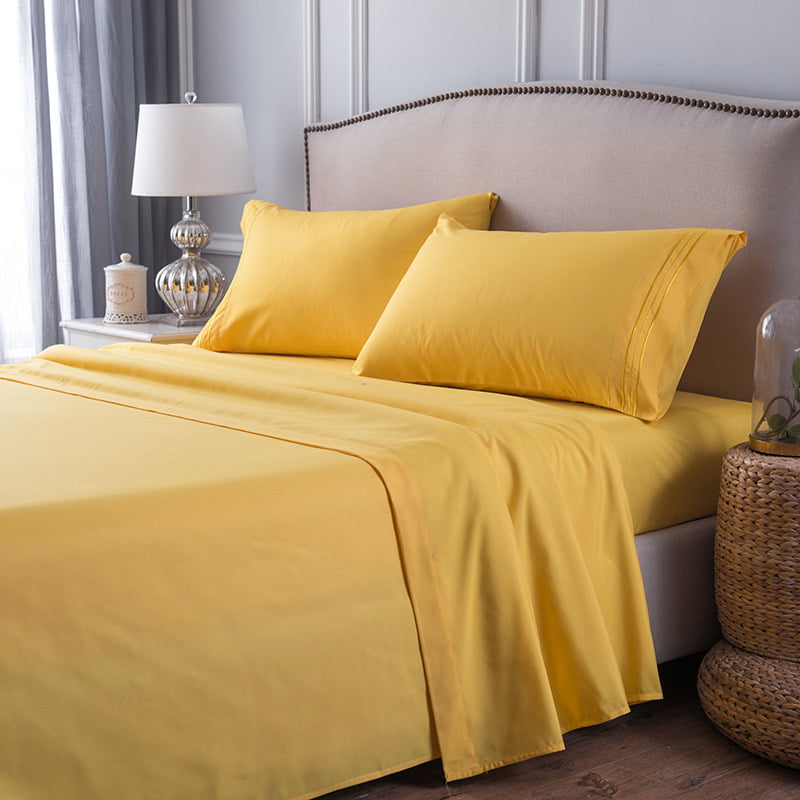
Percale is a one-over-one-under plain weave — the most basic textile construction — in which each weft thread passes alternately over and under each warp thread. This creates a matte, slightly crisp surface texture that many people associate with the feel of a well-made hotel sheet. Percale sheets feel cool and smooth against the skin, become softer and more comfortable with each wash without losing their structure, and are generally more durable than sateen weave because the tight even interlacing distributes wear across the fabric uniformly. The trade-off is that percale wrinkles easily — it is essentially impossible to remove all wrinkles from percale sheets without ironing — and it has a slightly rougher initial hand feel compared to sateen. For hot sleepers and anyone who prioritizes breathability and a crisp feel, percale is typically the better choice.
Sateen Weave
Sateen uses a four-over-one-under weave pattern in which more thread surface is exposed on the top face of the fabric, creating a smooth, lustrous finish that feels silkier and softer immediately out of the package than percale. Sateen sheets have a subtle sheen and drape more loosely than percale, which some people find more luxurious. The exposed thread surface that creates sateen's softness also makes it slightly more prone to snagging and pilling over time than percale, and less breathable because the denser surface traps more heat. Sateen is a good choice for cold sleepers who prioritize softness and a smooth hand feel, and for anyone who prefers sheets that look more polished on the bed with minimal effort.
Percale vs Sateen: Quick Comparison
| Feature | Percale | Sateen |
| Surface feel | Crisp, matte, cool | Smooth, silky, soft |
| Breathability | High | Moderate |
| Wrinkle resistance | Low (wrinkles easily) | Moderate |
| Durability | High | Moderate |
| Best for | Hot sleepers, humid climates | Cold sleepers, softness priority |
| Improves with washing | Yes, significantly | Moderately |
What's Included in a Sheet Set and What to Watch For
A standard bed sheet set typically includes a fitted sheet, a flat sheet, and one or two pillowcases depending on the bed size. Queen and king sheet sets generally include two pillowcases; twin and full sets often include one. Some sets — particularly in the budget category — are sold as "sheet sets" but include only a fitted sheet and pillowcases, omitting the flat sheet entirely. Always check the item count on the packaging before purchasing, since this omission is not always clearly stated in product titles.
Deep pocket fitted sheets deserve specific attention. Standard mattress depth is approximately 25–30cm, and most fitted sheets are designed for this range. If your mattress is significantly thicker — memory foam mattresses, pillow-top mattresses, and mattresses with toppers frequently reach 35–45cm — a standard fitted sheet will not stay on the corners and will pull off during sleep. Look for fitted sheets labeled "deep pocket" or "extra deep pocket" and check the stated pocket depth in centimeters rather than trusting the label alone. Some deep pocket sheets also include elastic around the entire perimeter of the fitted sheet rather than just at the corners, which holds the sheet in place more reliably on thick mattresses.
Sizing Your Sheet Set Correctly
Sheet set sizing follows mattress size names — twin, full, queen, king, California king — but the actual dimensions vary between manufacturers and between countries, which creates fit problems if you buy without checking. The table below shows standard US mattress dimensions alongside typical fitted sheet dimensions for reference:
| Mattress Size | Mattress Dimensions (US) | Typical Flat Sheet Size |
| Twin | 38" × 75" | 66" × 96" |
| Twin XL | 38" × 80" | 66" × 102" |
| Full / Double | 54" × 75" | 81" × 96" |
| Queen | 60" × 80" | 90" × 102" |
| King | 76" × 80" | 108" × 102" |
| California King | 72" × 84" | 102" × 110" |
Note that a standard king sheet set and a California king sheet set are not interchangeable despite both being called "king" — a California king mattress is narrower and longer than a standard king, and the fitted sheet pocket dimensions differ accordingly. Using the wrong size results in a fitted sheet that either won't reach the corners or bunches excessively. If you have a California king bed, confirm explicitly that the sheet set you're buying is sized for California king rather than assuming any "king" label will fit.
How to Match Sheet Sets to Your Sleep Style
The best sheet set for your needs depends significantly on how you sleep — your body temperature, your sensitivity to texture, and how much you move during the night. These factors matter more than price tier or brand reputation in determining whether you'll actually be comfortable in a particular set of sheets.
- Hot sleepers: Prioritize breathability above all else — linen is the best option if budget allows, followed by cotton percale. Avoid sateen weaves, microfiber, and any sheet marketed primarily for warmth or softness rather than cooling
- Cold sleepers: Sateen weave cotton or a cotton flannel sheet set retains more warmth than percale; microfiber also traps heat effectively for cold sleepers who want a budget option
- Sensitive skin: Long-staple cotton (Egyptian or Pima) with OEKO-TEX certification, or lyocell, both minimize friction and avoid chemical irritants from dyes or finishes — avoid heavily treated "wrinkle-free" or "easy care" sheets if skin sensitivity is a concern
- Night sweats: Linen or moisture-wicking lyocell handle perspiration most effectively; cotton percale is also solid; avoid microfiber and sateen weaves which trap moisture against the skin
- Kids' beds: Durability and easy washing matter more than luxury feel — mid-range cotton percale or microfiber works well; look for OEKO-TEX certification for direct skin contact on children's bedding
- Guest rooms: Crisp cotton percale in a neutral color reads as "hotel quality" to most guests and holds up well through irregular washing cycles; budget microfiber is also perfectly functional for low-frequency use
Caring for Your Sheet Set to Make It Last
Even a high-quality cotton sheet set will degrade prematurely if washed incorrectly. Heat is the primary enemy of sheet longevity: hot water washing and high-heat drying break down cotton fibers, shrink fabric, and fade colors faster than almost any other factor. Washing cotton and linen sheets in cool or warm water (30–40°C) and drying on a medium heat setting — or air drying — extends their life significantly compared to hot-wash, hot-dry cycles. Most quality sheet sets soften noticeably over the first 5–10 washes as manufacturing finishes wash out; sheets that feel stiff out of the package are not necessarily low quality — give them several washes before making a final judgment on feel.
Rotating between two or three sets of sheets extends the life of each set by reducing the frequency of washing any single set. Sleeping on the same sheets every night and washing weekly means each set goes through roughly 52 wash cycles per year; with two sets in rotation that drops to 26 cycles each, which meaningfully extends the point at which fabric starts to thin and pill. Store unused sheet sets folded inside one of their own pillowcases — a tidy storage method that also prevents sets from becoming separated in a linen closet over time.

 +86-159 5050 0822
 peter@rainbowhomefashion.com
 No.199 Yimin Road, Dateng DIstrIct, Yancheng City. Jiangsu Province, China